AI Adoption Risk: How to Prevent Skill Erosion
AI tools can quietly erode your team's skills if adoption isn't managed well. Learn how to keep humans sharp while using AI effectively.
AI adoption can quietly erode team skills when people hand off thinking, not just tasks: they stop building first drafts, stop building financial models from scratch, and stop noticing soft signals, so the underlying judgment weakens even as output stays productive. The risk is highest in writing-heavy, analytical, junior, and client-facing roles where skills develop through repetition and friction. Prevention means separating learning tasks from production tasks, using AI as a second opinion after a human draft rather than a first draft, requiring explanations of AI output, and rotating periods of manual-only work.
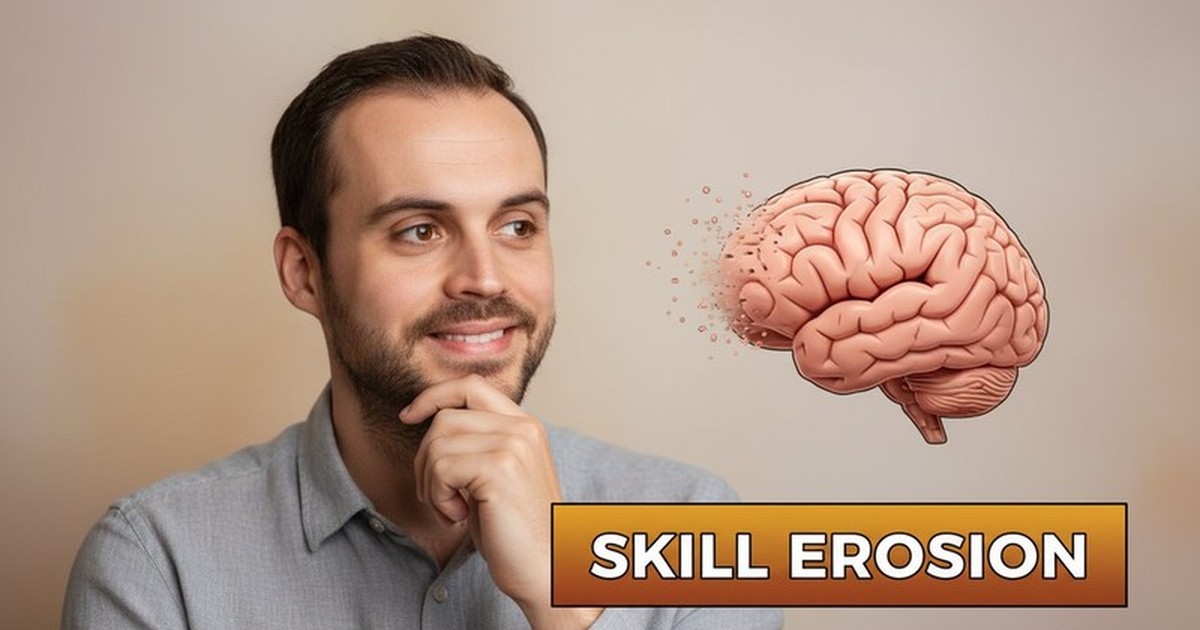
The Risk Nobody Talks About
Most conversations about AI risk focus on job replacement. Will the tool take my role? Will the team shrink? Those are valid questions. But they miss a quieter problem that is already happening in businesses right now.
People are getting worse at the skills they were hired for.
Not because they stopped working. Because they stopped learning. AI handles the thinking, the drafting, the analysis. The human clicks approve. Over time, the muscle that made them good at the job weakens. They still have the title. They still sit in the meetings. But the depth is gone.
This is skill erosion. And it is one of the most overlooked risks in AI adoption.
What Skill Erosion Looks Like in Practice
Skill erosion does not happen overnight. It creeps in through small habit changes that feel like efficiency gains.
A marketing manager stops writing first drafts and starts editing AI output. At first, the edits are heavy. Six months later, the edits are light. Not because the AI got better, but because the manager lost the instinct for what good copy sounds like.
A financial analyst stops building models from scratch and starts asking AI to generate them. The models look clean. But when something breaks, the analyst cannot debug it. They do not understand the logic anymore because they did not build it.
A project manager stops writing status updates by hand. AI summarizes the project data into a report. The reports are accurate. But the project manager no longer catches the soft signals between the data points. The tension in a team. The risk in a timeline that looks fine on paper.
In each case, the person is still productive. The output still ships. But the human judgment behind the output has thinned.
Which Roles Are Most at Risk
Skill erosion hits hardest where the learning happens through doing the work itself.
Writing-heavy roles. Copywriters, proposal writers, content strategists. Writing is a thinking tool. When you skip the blank page and go straight to editing, you skip the part where ideas form. The writing gets faster. The thinking gets shallower.
Analytical roles. Financial analysts, data analysts, reporting specialists. Building a model from raw data forces you to understand the relationships. When AI builds the model, you see the answer without understanding the path. That matters when the answer is wrong and nobody catches it.
Junior positions. This is where the risk is highest. Senior people have years of judgment to draw on. They can spot when AI output is wrong. Junior team members are still building that foundation. If AI does the foundational work for them, they never develop the judgment they need to grow into senior roles.
Client-facing roles. Account managers, consultants, sales leads. These roles require reading people and situations. AI can draft the email. It cannot teach you how to sense when a client is unhappy before they say it. If you stop doing the manual work of client communication, you stop developing that instinct.
The pattern is consistent. Roles where learning comes from repetition and struggle are the roles where AI-assisted shortcuts carry the highest long-term cost.
Why This Happens
The mechanism is simple. Skills develop through friction. You get better at writing by staring at a bad first draft and making it good. You get better at analysis by getting stuck in the data and finding your way out. You get better at client management by making mistakes and learning from the reaction.
AI removes that friction. And friction is uncomfortable, so people welcome the removal. The team moves faster. The manager sees improved output speed. Everyone feels like they are winning.
But speed is not the same as capability. A team that ships faster today but understands less about what they are shipping is building on a weaker foundation.
The compounding effect is what makes this dangerous. Skill erosion in month one is invisible. Over 18 months, it shows up as a team that cannot function without their tools. That is a dependency, not an advantage.
The Tinkerer Mindset: Staying in the Loop
I came from consulting, where you are paid to have answers. When I moved into building technology, the game changed. You are paid to find answers. To experiment. To break things and figure out why they broke.
That shift taught me something relevant here. AI does not erode your skills when you stay in the loop as the decision-maker. The risk shows up when people hand off the thinking, not just the tasks.
There is a difference between asking AI to draft something you will reshape, and asking AI to draft something you will approve. The first keeps you in the loop. The second takes you out.
I am not a traditional developer. I am a business consultant who learned to build. Every solution I create starts from the business problem. That means I use AI tools constantly, but I never lose sight of the process underneath. Because I started from the business side, I always know what the tool is supposed to accomplish and whether it actually did.
That is the key distinction. If you understand the problem deeply, AI is a lever. If you do not understand the problem and rely on AI to bridge the gap, AI becomes a crutch.
A Framework for Keeping Your Team Sharp
Preventing skill erosion does not mean using less AI. It means using AI differently. Here are four practices that work.
1. Separate learning tasks from production tasks
Not every task should be AI-assisted. Identify the tasks where doing the work manually builds important skills. Especially for junior team members. Protect those tasks from automation.
A junior analyst should still build models by hand at least once a month. A junior copywriter should still write first drafts from scratch for selected projects. This is not about slowing down. It is about keeping the skills that make AI assistance valuable in the first place.
2. Make AI the second opinion, not the first
The order matters. When your team starts with AI output and edits from there, they anchor to what AI produced. When they start with their own thinking and use AI to challenge or improve it, they stay sharp.
A practical rule: for complex work, draft your own version first. Then compare it to what AI produces. The comparison is where learning happens. Where did AI approach the problem differently? Was that approach better or worse? Why?
This takes more time. But it produces people who understand their work at a deeper level and can catch AI mistakes.
3. Require explanations, not just outputs
When a team member uses AI to produce something, ask them to explain the reasoning. Not the prompt they used. The logic of the output.
If they cannot explain why the financial model uses those assumptions, it is not ready. If they cannot explain why the proposal leads with that message, the proposal is not ready. The ability to explain the output is proof that understanding still exists.
This is also a useful diagnostic. When explanations start getting vague, that is an early indicator of skill erosion in action.
4. Rotate AI access intentionally
This sounds counterintuitive. But scheduled periods without AI tools can be valuable. Not as punishment. As training.
A team that does one week per quarter of manual work builds resilience and keeps baseline skills sharp. It also surfaces how dependent the team has become. That is useful information for a manager.
Think of it like physical training. If you always use a calculator, you lose the ability to estimate. Occasional mental math keeps the skill alive.
Building AI Adoption That Strengthens Your Team
The goal is not to slow down AI adoption. The businesses moving fastest with AI are building real advantages. Understanding the adoption gap makes it clear that hesitation has its own cost.
The goal is to adopt AI in a way that makes your team stronger over time, not more dependent.
That means thinking about AI adoption as a capability-building exercise, not just a productivity play. The question changes from “how do we automate this task?” to “how do we automate this task while keeping our team’s understanding intact?”
For teams just getting started, understanding what LLMs actually do is a good foundation. When people understand how the tool works, they use it more wisely and are less likely to over-trust its output.
The Three Warning Signs
Watch for these in your team:
Declining quality under pressure. When AI tools go down, can your team still deliver? If quality drops sharply without AI assistance, erosion has already set in.
Inability to explain work. When team members present AI-assisted work but cannot walk through the logic or defend the decisions, understanding is thinning.
Resistance to manual work. When people say “why would I do that manually?” about tasks that require judgment, the dependency has become cultural.
Any one of these signals is worth addressing. All three together mean the team’s foundation is weakening. And the AI tools are masking it.
The Bottom Line
AI adoption is a competitive advantage. Skill erosion turns it into a hidden liability.
The difference between the two outcomes is intentionality. Teams that adopt AI with clear boundaries around learning and judgment get faster and smarter. Teams that skip those boundaries get faster and more fragile.
You are building a team, not just a workflow. Protect the learning process that makes your team valuable. Use AI to remove mechanical work, not mental work. Keep humans in the loop where it counts.
The businesses that get this right will have teams that are both AI-augmented and deeply skilled. That is the combination that wins long term.
Want to make sure your AI adoption strengthens your team instead of weakening it? Schedule your free AI Readiness Assessment and we will map out an adoption plan that keeps your people sharp.
Frequently asked questions
What is skill erosion in AI adoption?
Skill erosion is the gradual weakening of a team's professional judgment when AI takes over the thinking behind a task and the human only reviews and approves. Output stays productive and even improves in speed, but because the person no longer struggles through the work themselves, the underlying skill that made them good at the job declines over time.
Which roles are most at risk of skill erosion from AI tools?
Writing-heavy roles (copywriters, proposal writers), analytical roles (financial and data analysts), junior positions, and client-facing roles (account managers, consultants) are most at risk because their skills develop through repetition and struggle. Junior employees carry the highest risk since they have not yet built the judgment needed to catch AI mistakes or grow into senior roles.
How can a business prevent AI from eroding its team's skills?
Four practices help: protect certain tasks (especially for junior staff) from AI assistance so learning still happens, make AI the second opinion by having people draft their own version first, require people to explain the reasoning behind AI-assisted output, and rotate in periods of AI-free manual work each quarter to keep baseline skills sharp.

Thom Hordijk
Founder
Get posts like this in your inbox every week
Weekly insights on AI and automation for B2B service businesses. No hype, just what works.
Related Articles
View all articles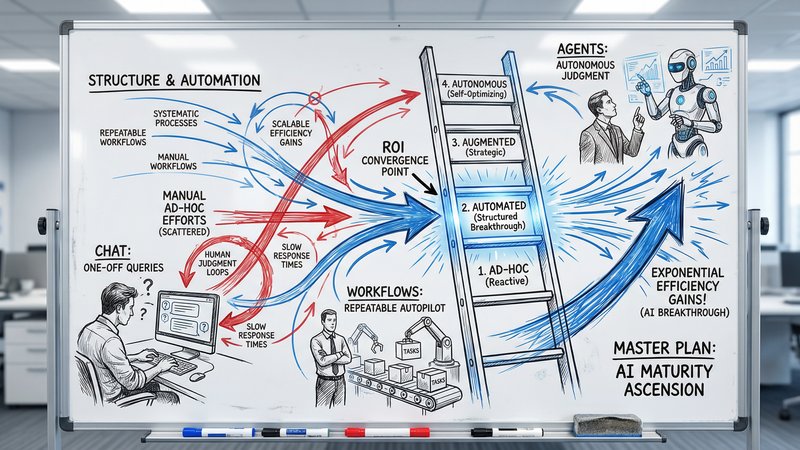
AI Chat vs Workflows vs Agents: Which Do You Need?
78% of businesses use AI but most just chat with it. The real ROI is in structured workflows. Here is how to know which approach fits your business.
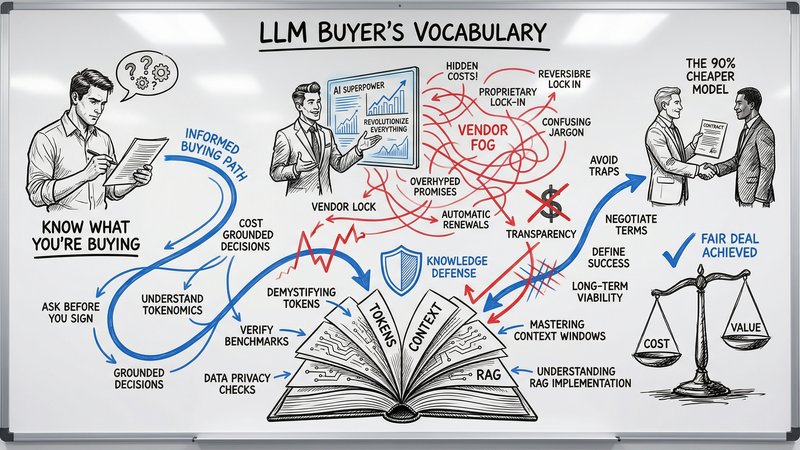
What Business Owners Need to Know About LLMs
LLMs power every AI tool you use, but most vendors won't explain how they work. Here are the concepts that change how you buy, evaluate, and negotiate AI.