How to Break Business Processes Into AI Agent Tasks
AI agents work when tasks are small and checkable. Learn the 5-step method to break down business processes for AI agents, with a worked example.
Break a business process into AI agent tasks by mapping the current state, cutting it into single-owner steps, writing a verifiable check for each step, assigning every step to a script, an AI agent, or a human, then ranking the steps by payoff. A task is only agent-ready when it has a defined output, a way to verify it, consistent input, and bounded judgment. Most failed AI agent projects fail at this assignment stage, before the technology is even involved.

Introduction
AI agents work when you hand them small, checkable tasks. Most businesses hand them entire jobs instead, and that is the main reason agent projects stall.
You have probably seen the pattern. Someone connects an AI tool to email or a CRM, tells it to “handle invoicing” or “manage follow-ups”, and two weeks later the whole thing is switched off after one embarrassing mistake. The tool takes the blame. The real problem was the assignment.
This article gives you the method we use in our own business and with clients. You will learn what makes a task agent-ready, the five step breakdown, and a worked invoicing example you can copy. No coding required.
Why AI Agent Projects Fail Before the Technology Starts
Most failed agent projects fail at the assignment stage, before any technology gets involved. The process was never broken into pieces an agent could own, so the agent got a vague job instead of a clear task.
Think about how you would delegate to a new employee on their first day. You would never say “handle our invoicing” and walk away. You would explain the steps. Where the billable hours live. Which clients get special rates. What to do when something looks off. An AI agent needs the same briefing, except it needs the briefing written down and it needs every step to be checkable.
When companies skip this, two things happen:
- The agent gets judgment calls it should never own. Pricing exceptions, unhappy clients, unusual requests. It improvises, and improvisation is where the embarrassing mistakes live.
- Nobody can tell whether the agent did well. If a step has no defined output and no check, “done” becomes a feeling. Feelings do not scale.
We covered the broader failure patterns in why 40% of AI agent projects fail. Poor task definition sits behind most of them. And if your process is messy to begin with, an agent will amplify the mess, a pattern we described in AI isn’t breaking your business, it’s exposing it.
“An AI agent is the fastest employee you will ever onboard. It is also the most literal one. It does exactly what the task says, which means the task has to say the right thing.”
The fix is a skill, and you can learn it in an afternoon.
What Makes a Task Ready for an AI Agent
A task is agent-ready when it has a clear input, a clear output, and a check that proves it was done right. Everything else is detail.
Here is the full checklist we apply. A task is ready for an AI agent when it meets these five characteristics:
| Characteristic | Ready | Red flag |
|---|---|---|
| Defined output | ”A draft invoice PDF per client" | "Handle billing” |
| Verifiable | Totals must match time tracking | ”Looks good to me” |
| Consistent input | Data arrives in the same format each time | Random emails, PDFs, and voicemails |
| Bounded judgment | Rules cover the normal cases | Every case needs experience to read |
| Worth automating | Happens weekly or daily | Happens twice a year |
The second row matters most. If you cannot write down how you would check the work, you do not understand the task well enough to delegate it. That rule holds for human delegation too. Agents just expose it faster.
Notice what is missing from this list: the task does not need to be simple. Agents handle complex work fine, drafting documents, classifying requests, reconciling data across systems. What they cannot handle is undefined work.
How to Break Down a Business Process in 5 Steps
Breaking down a process takes five steps, and the first one is the one everybody skips: write down what actually happens today.
- Map the current state. Follow one real instance of the process from start to finish. Write every step, including the workarounds. The official process says invoices go out on the 1st. The real one says someone exports a CSV on the 3rd and corrects two rates by hand. Write down the real one.
- Cut it into single-owner steps. Each step should produce one output and belong to one owner. If a step description contains the word “and”, it is usually two steps. “Draft and send the invoice” is two: drafting needs judgment, sending is a button press.
- Write the check for each step. Define how you would verify each step was done correctly. A number that must match. A status that must appear. A rule that must hold. “Invoice totals equal the hours in the time tracker” is a check. “The invoice looks right” is not.
- Assign each step: script, agent, or human. Fixed rules with structured data go to a script. Language, judgment within bounds, and pattern work go to an AI agent. Exceptions, relationships, and final say stay human. We compared these modes in agentic vs traditional workflow automation.
- Rank the steps by payoff. For each candidate, weigh how much it saves, how likely it is to work, and how much effort it takes to build. Big savings, high certainty, low effort goes first. This ranking picks your pilot for you.
The output of these five steps is a map: your process, broken into tasks with owners and checks. That map is worth more than any tool subscription, because every automation decision for that process now has a foundation.
A Worked Example: Invoicing, Broken Down
Here is what the method produces when we apply it to a process almost every service business runs: monthly invoicing.
The goal is simple to state: every client invoiced correctly, paid without chasing. Broken into single-owner tasks with checks, it looks like this:
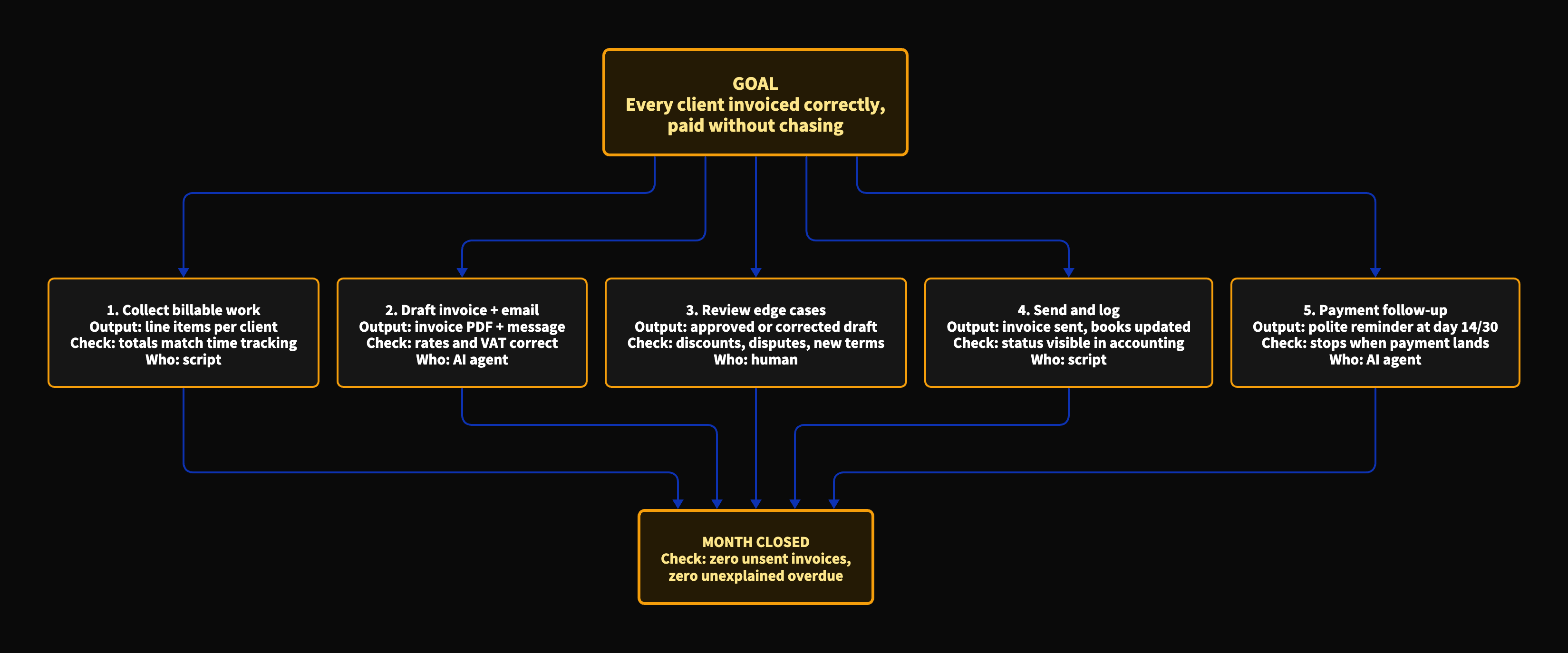
Walk through the assignments:
- Collecting billable work is a script. The data is structured and the rule is fixed. The check: line item totals match the time tracking system.
- Drafting the invoice and the email is an AI agent. It needs language and light judgment, correct names, correct rates, a human tone. The check: rates and VAT match the client agreement.
- Reviewing edge cases stays human. Discounts, disputes, a client on new terms. This is bounded to a short list, so it costs minutes.
- Sending and logging is a script again. The check: the invoice shows up in accounting with the right status.
- Payment follow-up is an agent. Polite, well-timed reminders that stop the moment payment lands.
A services team running this pattern typically goes from five or six hours of invoicing a month to under one. The hour that remains is the edge case review, which is the judgment work a human should be doing anyway. In our own operation, this same method decides what our internal agents pick up. Nothing gets handed over without a written check.
“Break the process down first. The tool choice becomes obvious afterwards, and sometimes the right tool turns out to be a checklist.”
Red Flags: When a Process Is Not Ready Yet
Some processes should not be handed to agents yet, and forcing them is how budgets disappear. Watch for these signals during your breakdown:
- You cannot find two instances that ran the same way. The process lives in someone’s head and changes shape per case. Standardize first, automate second.
- The exceptions outnumber the rules. If most cases are special cases, you do not have a process yet. You have a queue of judgment calls.
- The inputs are chaos. Data scattered across inboxes, chat threads, and screenshots. Fix the intake before you automate what follows it.
- Nobody can say what “correct” means. If your team debates what the right output looks like, an agent will not settle the debate. It will just produce wrong answers faster.
A red flag does not kill the project. It reorders it. Each of these problems is worth fixing on its own, and the breakdown is what makes them visible.
From Breakdown to Pilot
Once the map exists, start with one task, prove it, and expand from there. The ranking from step five already told you where to start: the highest impact, highest certainty, lowest effort task on the map.
This is why we push back on AI roadmaps that promise a transformed business in a year. The map gives you something better: a pilot you can ship in weeks, with a check that proves it worked. We wrote about that logic in why your AI project needs a pilot, not a roadmap.
A good first pilot from the map:
- Ships in 2 to 4 weeks
- Has one owner and one written check
- Saves measurable hours from day one
- Leaves the map ready for task number two
Each completed task also makes the next one cheaper, because the plumbing, the data access, and the habits are already in place.
Conclusion: The Skill Is the Breakdown, Not the Build
AI agents are becoming a commodity. The map of your business, broken into tasks with owners and checks, is the part nobody can buy off the shelf.
The five steps once more: map the current state, cut it into single-owner steps, write a check for each, assign script, agent, or human, and rank by payoff. Run this on one process this week. Invoicing, client reporting, and lead follow-up are all strong first candidates.
Want help mapping your first process? Schedule your free AI Readiness Assessment and we will break down one critical workflow with you and show you exactly which tasks are ready for agents today.
Frequently asked questions
How do I know if a task is ready for an AI agent?
A task is agent-ready when it has a clear, defined output, a way to verify the output is correct, consistent input formatting, and bounded judgment calls. If you cannot write down how you'd check the work, the task isn't well enough defined to hand to an agent yet.
What are the 5 steps to break down a business process for AI agents?
Map the current state (what actually happens, including workarounds), cut it into single-owner steps, write a verifiable check for each step, assign each step to a script, an AI agent, or a human, then rank the steps by payoff: how much each saves, how likely it is to work, and how much effort it takes to build. The best-scoring step is your pilot.
Which tasks should stay human instead of going to an AI agent?
Judgment calls that fall outside defined rules, such as pricing exceptions, unhappy clients, and unusual one-off requests, should stay human. Fixed rules on structured data go to a script; language and bounded judgment go to an AI agent; genuine exceptions and final say stay with a person.

Thom Hordijk
Founder
Get posts like this in your inbox every week
Weekly insights on AI and automation for B2B service businesses. No hype, just what works.
Related Articles
View all articles
How to Build a Multi-Channel Outreach System for B2B
Most B2B outreach breaks down because of missed follow-ups and outdated CRMs, not bad messaging. Here is how automation fixes the system behind it.
Why Workflows Feel Different in the AI Era
AI workflows handle exceptions, adapt to context, and improve over time. Here's what that means for your operations.

Agentic vs Traditional Workflow Automation
Traditional workflow automation is rigid. Pure AI agents are unreliable. Agentic workflows combine deterministic execution with AI reasoning for results that hold up.