Is AI Finally Built for Small Businesses?
AI used to demand enterprise budgets and IT teams. That's changed. Here's what's different now and how to tell if it's right for your business.
Yes: AI is now practical for small businesses because tool costs dropped from tens of thousands of euros to tens of euros per month, capabilities became modular add-ons instead of all-or-nothing systems, and no-code platforms like Zapier and Make absorbed the technical integration work. A good fit is a business with repetitive, stable, measurable tasks and at least a basic digital setup, typically starting with a single 90-day pilot costing €500-€5,000.
The Gap That Is Finally Closing
A few years ago, the answer was no.
AI was real, the results were real, but the price of entry kept most small and mid-sized businesses out. You needed a data team to prep and clean your inputs. You needed engineers to build and maintain the integrations. You needed a six-figure budget before you could even test whether it worked.
The businesses benefiting from AI were banks, logistics companies, and software firms with the infrastructure to absorb that cost. A consultancy with 20 people, a marketing agency with 15, an accounting firm with 30: they read about AI breakthroughs in the news and kept doing things the way they always had.
That picture has changed. Not because AI became simpler to understand, but because the tools built around it became simpler to use. The complexity got absorbed by the platforms. What used to require an engineering team now requires a subscription and an afternoon.
If you have been watching AI from the sidelines, the picture is clearer now than it was two years ago.
What Changed
Three shifts happened in parallel, and together they flipped the economics.
The tools got lighter
Early enterprise AI required custom infrastructure: private servers, dedicated model training, months of integration work. Today, the same capability is delivered as software you access through a browser.
Tools like ChatGPT, Claude, and Gemini are available for €20 to €30 per user per month. Zapier, Make, and n8n let you connect them to your existing systems without writing code. HubSpot, Notion, and Pipedrive have built AI features directly into the products you are probably already paying for.
The cost of adding AI to a workflow has dropped from tens of thousands of euros to tens of euros per month. That shift alone opened the door for businesses of any size.
AI became modular
The old model was all-or-nothing: a system that replaces an entire process end to end. That is hard to implement, hard to trust, and expensive to maintain.
The new model is plug-and-play: a tool that handles one specific step in a workflow you already run. Your proposal process stays yours. AI handles the first draft. Your client onboarding stays yours. AI drafts the follow-up email. Your reporting stays yours. AI summarizes the raw data.
This approach is easier to evaluate, easier to reverse, and easier to extend. You are not betting the process on one tool. You are adding one capability at a time.
No-code platforms absorbed the technical work
The largest barrier for small businesses was never willingness. It was capability. Most owners of 10 to 50 person businesses do not have technical staff. They have no one to build the technical connections between tools.
No-code and low-code platforms have taken that bottleneck away. Zapier has over 7,000 app integrations that can be connected with point-and-click logic. Make lets you build complex multi-step automations with a visual drag-and-drop canvas. There are workflow templates for common use cases like lead follow-up, invoice processing, and meeting summaries that you can copy and adapt in an hour.
You still need to understand what you want to automate. But the technical execution is no longer the limiting factor.
What AI Actually Does for Service Businesses
The practical question is not whether AI is intelligent. It is whether AI is fast at the specific types of work your team does.
Specifically, AI handles work that is:
- Repetitive. The same task done the same way, over and over.
- Text-heavy. Reading, summarizing, drafting, formatting.
- Pattern-based. Routing, categorizing, flagging.
For a B2B service business, that covers a lot of ground.
Client communication. Drafting follow-up emails after meetings. Summarizing call notes into action items. Writing proposals from a set of inputs you define. A marketing agency doing this for 20 active clients a month might save four to eight hours per week on writing alone.
Internal reporting. Pulling data from your project management tool, your CRM, and your invoicing system into a weekly summary. For a 15-person consultancy, generating partner reports used to take a full day. With automated data collection and AI-generated commentary, it takes under an hour.
Lead research. Looking up a company before a sales call: their website, recent news, LinkedIn presence. A tool connected to those sources can have a brief ready in two minutes. A person doing it manually takes 20 to 30.
Document handling. Extracting key terms from a contract. Parsing supplier invoices. Categorizing expense receipts. These are not glamorous tasks, but they eat hours every week.
None of this replaces the judgment your team applies. It removes the mechanical work around that judgment, so your team spends more time on the part only they can do.
Who It Is Actually For
Not every business is ready, and not every problem is worth automating. But certain conditions make AI a strong fit.
You have repetitive, high-volume tasks. If your team does the same thing more than ten times a week, that task is worth looking at. Below that threshold, the setup cost may outweigh the benefit.
Your processes are mostly stable. AI works well when the workflow is consistent. If your process changes constantly, or if every project is completely unique, AI has less to grab onto.
You can measure the current state. You need to know how long something takes now before you can prove AI made it faster. If you cannot put a number on the current effort, you cannot evaluate the improvement.
You have at least a basic digital setup. AI tools connect to other software. If your operations run on paper, spreadsheets, or disconnected systems, the first priority is getting your data organized. The AI comes after.
This is not a checklist where you need to tick every box. But the more of these that apply, the more clearly the math works in your favor.
The Questions to Ask Before You Buy Anything
The biggest mistake small business owners make with AI is buying before defining. They sign up for a tool because it looks impressive in a demo, without a clear answer to: what specific problem am I solving, and how will I know if it worked?
Before committing to any AI tool or project, answer these four questions:
What is the task? Name it specifically. Not “marketing” but “writing the first draft of our monthly client newsletter.” Not “admin” but “extracting line items from supplier invoices into our accounting system.”
How long does it take now? Get a real number. Log it for a week if you need to. Without a baseline, you cannot measure progress.
What does success look like? Define a threshold before you start. “We cut this from four hours to one” or “we reduce errors from ten per month to two.” Vague targets produce vague results.
Who owns it? Assign one person to run the trial. Not a committee. One person with time allocated and a clear deliverable.
If you cannot answer all four, you are not ready to buy. You are ready to spend time getting clear on the problem first.
Where to Start
The best first project is the task your team dreads most.
Not because AI has any particular skill at making things more enjoyable, but because the pain level is the best proxy for impact. High pain means high frequency, high time cost, or both. Those are the conditions where automation delivers the clearest return.
For most service businesses, the candidates look like this:
- Proposal or quote preparation
- Meeting notes and follow-up emails
- Weekly or monthly reporting
- Lead research before sales calls
- Invoice processing and expense categorization
Pick one. Run a 90-day trial with a specific hypothesis and a clear metric. Most pilots in this range cost between €500 and €5,000 depending on the tools and any integration work required. At that scale, the downside of a failed experiment is manageable, and the upside of a successful one compounds quickly.
The businesses capturing real value from AI are not doing it all at once. They proved one thing, built confidence, and expanded from there. That is the pattern worth copying.
For a deeper look at how to structure a trial that actually produces a usable result, the pilot framework here walks through the approach step by step.
The Risk of Waiting
There is a real cost to moving slowly, and it is not abstract.
The businesses that committed to AI two years ago have been compounding gains. Their delivery is faster. Their costs are lower. They have figured out what works and what does not, and they have built that knowledge into their operations.
The businesses sitting on the sidelines will still be able to adopt AI. But they will be starting from zero at a point when their competitors are already on version three.
The other risk is subtler. As more businesses close the adoption gap, AI-augmented delivery will become a baseline client expectation. Faster turnarounds, better prepared teams, more responsive communication. When clients start to expect that, the businesses not delivering it will feel the gap in retention and referrals, not just in internal efficiency.
You do not need to be an early adopter. But the window for getting ahead of this is narrowing.
What “Ready” Actually Means
AI tools in 2026 work with the systems you already have. They do not require a rebuilt tech stack or a data scientist. They require a clear problem, a trial, and a way to measure what happens.
If you run a B2B service business with repeatable work and a team spending time on tasks that follow a pattern, you have the conditions for AI to deliver real value. Understanding what is blocking adoption is often the more useful question than waiting for tools to improve further. The tools are good enough. The question is whether the process is clear enough to automate.
Want to know which workflows in your business are the strongest candidates for AI? Take the AI Readiness Assessment and we will map your current processes against what is practical to automate right now.
Frequently asked questions
Is AI actually affordable for small businesses now?
Yes. Tools like ChatGPT, Claude, and Gemini cost €20-€30 per user per month, and no-code platforms like Zapier and Make connect them to existing systems without engineering work, dropping the entry cost from tens of thousands of euros to tens of euros monthly.
What tasks should a small business automate with AI first?
Start with the task your team dreads most and does more than ten times a week, such as client follow-up emails, weekly reporting, lead research before sales calls, or invoice and expense processing. High pain and high frequency are the clearest signals of where AI delivers the most value.
How do you know if your business is ready to adopt AI?
You're ready if you have repetitive, high-volume tasks, mostly stable processes, a measurable baseline for how long tasks currently take, and at least a basic digital setup connecting your tools. If your operations still run on paper or disconnected spreadsheets, organize the data first.

Thom Hordijk
Founder
Get posts like this in your inbox every week
Weekly insights on AI and automation for B2B service businesses. No hype, just what works.
Related Articles
View all articles
Why Security Is the Real AI Adoption Bottleneck
Most AI adoption stalls on security concerns, not cost or talent. Learn how to address data privacy, GDPR, and AI security for business the right way.
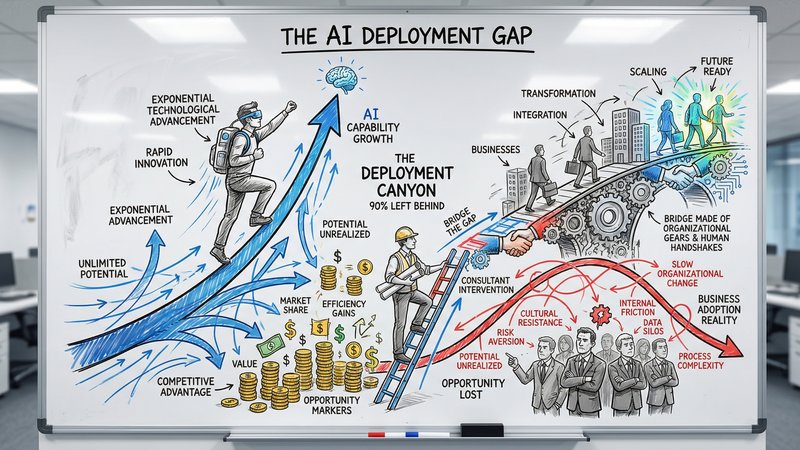
90% of Businesses Don't Use AI. That's the Opportunity.
90% of US businesses still don't use AI in production. The gap between capability and deployment is where the real opportunity lives for service businesses.
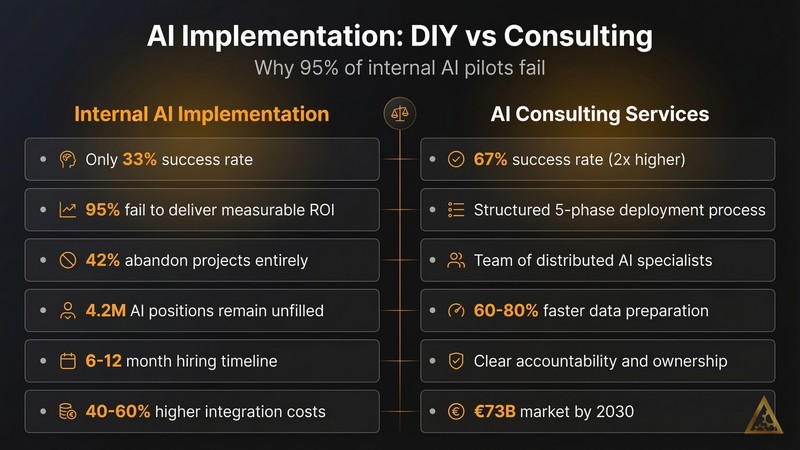
Why AI Deployment Needs Consulting Services
49% of businesses piloted AI tools in 2024. Only 4% deployed them at scale. The gap between buying AI and getting value from it is a services problem, not a technology one.