Why AI Deployment Needs Consulting Services
49% of businesses piloted AI tools in 2024. Only 4% deployed them at scale. The gap between buying AI and getting value from it is a services problem, not a technology one.
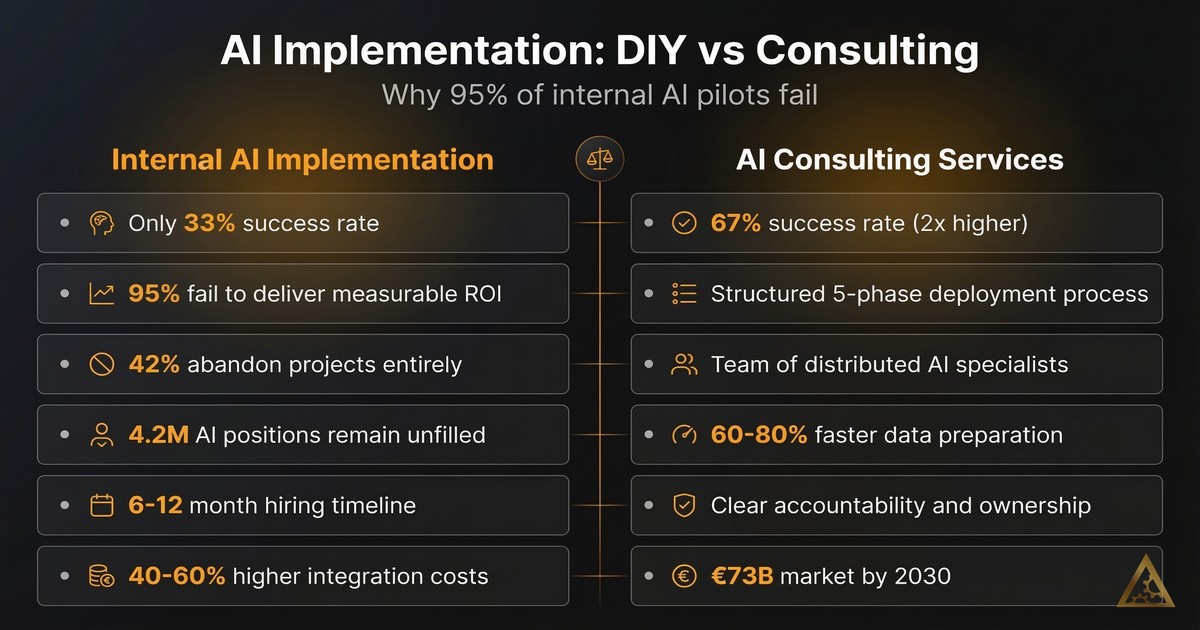
AI deployment fails at scale (only 4% of businesses that piloted AI in 2024 deployed it broadly) because data preparation, legacy system integration, and ongoing maintenance are services problems, not technology gaps. Externally supported AI implementations succeed at nearly 2x the rate of internal builds (67% vs 33%), which is why structured consulting engagements consistently outperform DIY deployment.
The Number That Should Change How You Think About AI
49% of businesses piloted AI tools in 2024. Only 4% deployed them at scale. That gap represents billions in wasted investment, and it reveals why enterprise AI deployment is fundamentally a services challenge.
The technology works. GPT-4, Claude, Gemini, open-source alternatives. They all perform well in demos and controlled environments. The problem starts the moment you try to embed them into real business operations. Data is messy. Systems do not talk to each other. Teams are not ready. Processes need redesigning before any model can improve them.
MIT’s NANDA Institute confirmed this in 2025: 95% of generative AI pilots fail to deliver measurable ROI. And the fallout is accelerating. 42% of companies abandoned most of their AI initiatives in 2025, up from 17% in 2024. Businesses are not just failing to scale AI. They are actively retreating from it.
This retreat is premature. The companies that succeed with AI almost always rely on structured implementation support. Externally procured or partnered AI solutions succeed at nearly 2x the rate of internal builds (67% vs 33%). That statistic alone explains why AI consulting for businesses has become one of the fastest-growing service categories in technology.
Why AI Implementation Services Close the Deployment Gap
Buying an AI tool is the easy part. Deploying it into production, integrating it with legacy systems, training your team, and maintaining it over time requires a completely different set of skills.
Most businesses underestimate three areas.
Data preparation dominates the timeline. Data prep consumes 60-80% of an AI project’s timeline and budget. Your CRM has duplicates. Your ERP exports data in a format the AI tool cannot read. Client records are scattered across spreadsheets, email threads, and project management tools. Before any model can deliver value, this data needs cleaning, structuring, and connecting. This is hands-on services work, not a product feature.
Integration with legacy systems is expensive. Connecting AI tools to existing infrastructure increases costs by 40-60%. The older your systems, the higher the cost. A consulting partner who has done this integration work before can identify the cheapest path through your specific stack, saving weeks of trial and error.
Maintenance never stops. Annual AI maintenance runs 15-30% of your total infrastructure cost. Models drift. Data pipelines break. Business rules change. As we covered in our analysis of why automation rules break over time, the real cost of any automated system lives in the ongoing upkeep, not the initial build. Most companies do not budget for this, and most internal teams are not staffed for it.
These three factors explain why the AI consulting market reached €14 billion in 2024 and is projected to hit €73 billion by 2030. Businesses are learning, often the hard way, that AI deployment is services-heavy work.
The Talent Problem Makes Self-Implementation Risky
Even if you wanted to handle AI deployment internally, the talent market makes it extremely difficult. 4.2 million AI positions remain unfilled globally, with a demand-to-supply ratio of 13:1.
That means for every qualified AI engineer or data scientist available, 13 companies are competing for them. Salaries reflect this scarcity. And even when you hire the right person, a single AI engineer cannot cover the full spectrum of skills required: data engineering, model selection, prompt design, systems integration, change management, and ongoing optimization.
A consulting partner brings a team with distributed expertise across all of these areas. You get access to specialists who have solved similar problems for other companies in your industry, without the 6-12 month hiring timeline and the risk of a bad hire.
This is particularly relevant for mid-market companies. You are large enough to benefit from AI, but not large enough to justify building a dedicated AI team. Enterprise AI deployment through a consulting partner gives you enterprise-grade implementation at a fraction of the fixed cost.
What AI Consulting for Businesses Actually Looks Like
There is a misconception that AI consulting means paying someone to write a strategy deck. The consulting that delivers results looks nothing like that.
Phase 1: Assessment (1-2 weeks). A good consulting engagement starts by mapping your current workflows, data sources, and systems. The goal is to identify the highest-ROI opportunity, the one process where AI will generate measurable returns fastest. This is the approach we advocate in our guide on running AI pilots instead of roadmaps. Start with one workflow. Prove it works. Then expand.
Phase 2: Data and integration work (4-8 weeks). This is where the bulk of the time goes. Cleaning data, building connectors between systems, setting up the infrastructure the AI tool needs to function in production. Most of this work is invisible to stakeholders, which is why it is so often underestimated and underfunded.
Phase 3: Deployment and testing (2-4 weeks). The AI tool goes live with a small team. Performance is measured against clear baselines. Edge cases are identified and handled. The goal is to reach a stable, production-ready state before rolling out more broadly.
Phase 4: Training and handoff (1-2 weeks). Your team learns how to use, monitor, and maintain the system. Documentation is created. Escalation paths are defined. The consulting partner steps back into an advisory role.
Phase 5: Ongoing optimization. Models degrade. Business needs shift. Quarterly reviews and adjustments keep the system performing. This is where the 15-30% annual maintenance cost goes.
Companies using structured implementation approaches consistently reach positive ROI faster than those who improvise their way through deployment.
The Real Barriers to Enterprise AI Deployment
Technology is rarely what holds companies back. The most common AI adoption barriers are organizational.
No clear ownership. AI projects that sit between IT and operations often have no single accountable owner. When nobody owns the outcome, nobody drives it forward. A consulting partner provides that accountability during the critical deployment phase.
Unrealistic expectations. Leadership expects AI to “transform the business” within a quarter. When that does not happen, support evaporates. Structured consulting engagements set realistic milestones and communicate progress in business terms, not technical jargon. Revenue gained, hours saved, error rates reduced.
The wrong starting point. Many companies start with the most complex, high-stakes process because the potential ROI looks largest on paper. In practice, starting with a simpler workflow builds organizational confidence and surfaces integration challenges at lower risk. A consulting partner steers you toward the right first project based on experience across dozens of similar engagements.
Confusing AI categories. The difference between a chatbot, a workflow automation, and an AI agent matters enormously for scoping and budgeting. Misunderstanding what type of AI solution you need leads to misaligned vendor selection, blown timelines, and wasted spend. Experienced consultants match the right tool to the right problem.
Production reliability. Getting an AI prototype working is one thing. Making it reliable enough for production is another challenge entirely. Edge cases, error handling, fallback logic, monitoring, and alerting all need to be designed and built. This is engineering work that most off-the-shelf tools do not provide out of the box.
How to Evaluate AI Implementation Services
Not all consulting is created equal. Here is what to look for when evaluating an AI implementation partner.
They start with your process, not their product. If the first conversation is about their proprietary platform or a specific AI model, they are selling a solution before understanding your problem. The best partners spend the first engagement understanding how your business actually operates.
They quantify expected ROI before starting. You should know, in specific terms, what success looks like before any work begins. Hours saved per week. Revenue increase per quarter. Error rate reduction. If the consulting partner cannot define these metrics upfront, they are guessing.
They have relevant industry experience. AI deployment for a professional services firm looks very different from AI deployment for an e-commerce company. Ask for case studies from businesses similar to yours. The integration challenges, data structures, and compliance requirements vary significantly across industries.
They plan for maintenance from day one. Any partner who quotes a build cost without addressing ongoing maintenance is setting you up for a system that degrades within months. Maintenance should be part of the initial proposal, with clear costs and responsibilities defined.
They transfer knowledge, not just deliverables. The goal is to make your team capable of operating and evolving the system independently. If the consulting partner’s business model depends on your permanent reliance on them, their incentives are misaligned with yours.
The Cost of Waiting
Every month you spend trying to figure out AI deployment internally is a month your competitors with consulting support are pulling ahead. The time-to-ROI advantage compounds quickly.
Consider a simple example. A professional services firm spends 40 hours per week on proposal writing. An AI implementation partner can reduce that by 60% within 90 days, freeing 24 hours per week. At a blended rate of €150 per hour, that is €3,600 per week, or roughly €187,000 per year in recovered capacity.
Attempting the same project internally, with limited AI expertise and competing priorities, typically takes 6-9 months to reach the same result. That delay costs €72,000-€108,000 in unrealized efficiency gains. The consulting fee pays for itself in the time saved getting to production.
The AI consulting market is growing at 30%+ annually for a reason. Businesses that have tried the DIY approach are switching to structured implementation because the math works.
If you are evaluating AI for your operations and want to understand where the highest-ROI opportunities are, take our AI Readiness Assessment. It takes five minutes and gives you a clear picture of where consulting support would generate the fastest returns for your specific business.
Frequently asked questions
Why do most AI pilots fail to reach production?
MIT's NANDA Institute found 95% of generative AI pilots fail to deliver measurable ROI, mainly because businesses underestimate data preparation (60-80% of project timelines), legacy system integration costs, and ongoing maintenance needs. The technology itself performs well in demos; the failure happens when embedding it into real operations.
Is AI consulting worth the cost compared to building internally?
Externally procured or partnered AI solutions succeed at nearly 2x the rate of internal builds (67% vs 33%), and a global 13:1 demand-to-supply ratio for AI talent makes internal hiring slow and risky. A structured consulting engagement typically reaches ROI in 90 days versus 6-9 months for an internal team with limited AI expertise.
What does a good AI implementation engagement actually involve?
It follows five phases: a 1-2 week assessment to find the highest-ROI workflow, 4-8 weeks of data and integration work, 2-4 weeks of deployment and testing, 1-2 weeks of team training and handoff, and ongoing quarterly optimization. Most of the effort goes into the invisible data and integration work, not the visible tool itself.

Thom Hordijk
Founder
Get posts like this in your inbox every week
Weekly insights on AI and automation for B2B service businesses. No hype, just what works.
Related Articles
View all articles
Why Security Is the Real AI Adoption Bottleneck
Most AI adoption stalls on security concerns, not cost or talent. Learn how to address data privacy, GDPR, and AI security for business the right way.
Is AI Finally Built for Small Businesses?
AI used to demand enterprise budgets and IT teams. That's changed. Here's what's different now and how to tell if it's right for your business.
90% of Businesses Don't Use AI. That's the Opportunity.
90% of US businesses still don't use AI in production. The gap between capability and deployment is where the real opportunity lives for service businesses.